In 2010 a new major commentary on 1 Corinthians appeared, by Roy Ciampa and Brian Rosner:
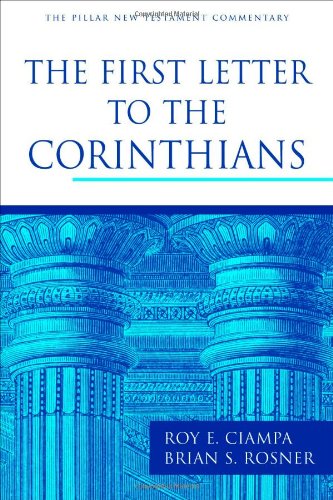
The commentary has just been reviewed by Korinna Zamfir in the Review of Biblical Literature. Zamfir raises some interesting questions about the ways in which assumptions concerning the contexts of the letter affect our interpretation.
For Zamfir, Ciampa and Rosner are so focused on Paul’s “Jewish” background, that they unhelpfully downplay the Greco-Roman characteristics of Paul himself, and the audience to which he is writing. Zamfir is disappointed that the authors reject Margaret Mitchell’s contention that the letter utilises a Greco-Roman macro-rhetoric. Zamfir also points to an implication in the commentary that “pagan” society had no regard for sexual morality, whereas the (Jewish) Paul was committed to high ethical standards. She wishes Ciampa and Rosner were more sensitive to the complexities of religious life for “Gentile Christians coming from a Greco-Roman cultural and religious background” and concludes that throughout the work the Greco-Roman background has been disappointingly downplayed.
Is this fair? I think it’s true that the great strength of Ciampa and Rosner’s commentary is its attention to the Old Testament and Jewish themes that illuminate the letter – themes that are all too absent in Margaret Mitchell’s analysis. It may be that the strong emphasis on OT/Jewish contexts in the letter is in fact a reaction to a perceived over-emphasis on Greco-Roman backgrounds in many examinations of the Corinthian correspondence over the last couple of decades (this sort of corrective was certainly the burden of Rosner’s doctoral dissertation).
My own view is that Ciampa and Rosner’s emphases, while provocative and debatable at times, are useful in bringing the Old Testament and Judaism back into the picture in the study of this letter. I would want to tweak their presentation of “Jewish” ethics by insisting that Jewish ethics was itself impacted and shaped by the Hellenistic world; and I would probably give a little more prominence to the Greco-Roman character of the letter’s micro-rhetoric (but not macro-rhetoric). But I think that the commentary is a useful contribution in calling attention to neglected elements of the first century context of the letter.


 Corinthian Matters
Leave a comment