Category: Commentaries
-
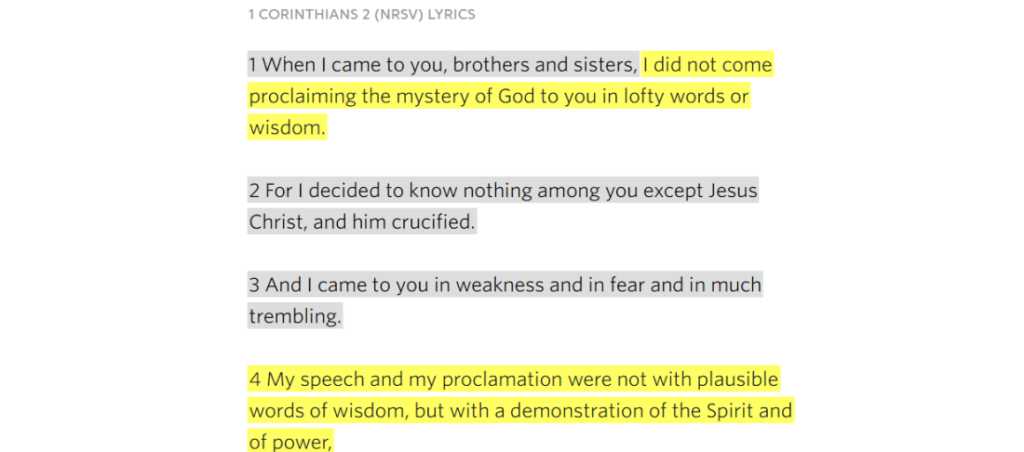
Crowdsourcing Paul’s Letters to Corinth
Last week I noted a few of the many new tools and online sites available for reading and interpreting Paul’s Corinthian correspondence. I was a little surprised to find so few digitally annotated commentaries on 1 and 2 Corinthians given the relative ease of coding a text through TEI markup language, the availability of online platforms that have simplified the process, and the currency of crowdsourcing in the digital…
-
Wiley Blackwell Companion to Patristics (ed. Parry)
What do Patristic studies have to do with Corinth? Quite a lot. One of the interesting bits of research I completed over the last several years was working through the Roman and late antique references to Corinth, Kenchreai, and the Isthmus in the TLG to study the changing patterns of discourse about the city and…
-
George Guthrie: A new commentary on 2 Corinthians
George Guthrie, who recently published a massive new commentary on 2 Corinthians for the Baker Exegetical Commentary on the New Testament series, talks about his book in this two part interview at the website Books at a Glance: Interview with George Guthrie, author of 2 CORINTHIANS (Baker Exegetical Commentary on the New Testament), Part 1 Interview with George…
-
A New Bibliography for 1 and 2 Corinthians
It’s easy these days to locate books and articles related to St. Paul’s letters to the Corinthians. Bibliographies have proliferated online and lists of select commentaries and introductions are a dime a dozen. See, for a few examples, the bibliographic lists compiled on Bible.org, BiblicalStudies.org (with some PDF documents), Baker publishing group, the United Methodist…
-
Conybeare and Howson, on the True and Faithful Representation of the Apostle (1852)
For Friday’s picture of Corinth, I offer another vision from 19th century New Testament scholars. This one comes from W.J. Conybeare and Howson’s The Life and Epistles of St. Paul (1852), a major work of biography in its day and a source for Coleman’s sketch of a “most hopeless city” posted two weeks ago. Conybeare…
-
Augustus Neander, on the reason for Paul’s sojourn (1844)
Last week, I excerpted a text from Lyman Coleman’s historical atlas of the bible (1855) about the Paul’s visit to the “most hopeless city of Corinth.” I decided to trace Coleman’s ideas about Corinth and the consequences of geography. Coleman notes that for his sections on Paul’s travels, he consulted H.B. Hackett’s A Commentary on…
-
Lyman Coleman, on the most hopeless city of Corinth (1855)
One of the projects I’m working on this year is a study of how ancient and modern writers have interpreted the historical fortunes of Corinth through the lens of its eastern landscape, the Isthmus. How did a land bridge become so consequential for writing the history of the city? It’s a topic I’ve commented on…
 Corinthian Matters