Category: Peloponnese
-
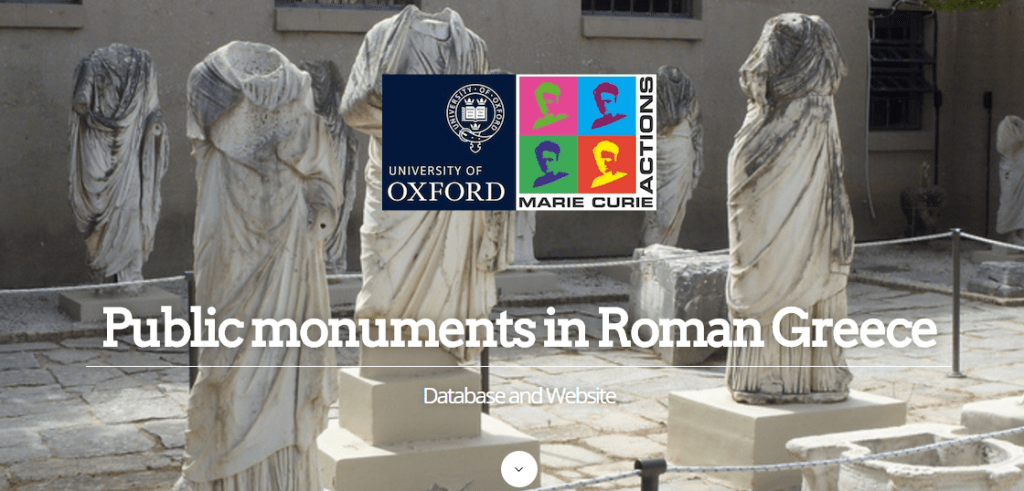
Public Monuments in Roman Greece: A New Database
A colleague sent me this link to Dr. Christopher Dickenson‘s new database and website devoted to the public monuments of Roman Greece. The platform and the content are still under development, but the website already makes available records for a substantial number of monuments known from Pausanias for three cities of Roman Greece. With its aim to presen all monuments known from text and…
-

Ancient City: Application of Novel Geo-Information Technologies in Ancient Greek Urban Studies
I received an email from Jamie Donati who kindly shared with me more information about the Ancient City project and website, which provides the: aims and scope of the project (including digitization, remote sensing, geophysical mapping, GIS analysis, and dissemination) archaeological sites of the Peloponnese under study technical reports about geophysical survey and remote sensing presentations and publications (with available downloads)…
-
Open Access and the Centre for Spartan and Peloponnesian Studies
The Centre for Spartan and Peloponnesian Studies at the University of Nottingham was founded in 2005 to generate dialogue about all aspects of Peloponnesian and Spartan history from prehistory to the modern age and strengthen connections with scholars within the U.K. and abroad. The Centre hosts visiting faculty, seminars, and conferences. In case you missed the notice in the Ancient World Online, the Centre also recently…
-
Bridge of the Untiring Sea (Gebhard and Gregory, eds.)
I finally have my hands on Bridge of the Untiring Sea: the Corinthian Isthmus from Prehistory to Late Antiquity, fresh off the press (December 2015) from the Princeton office of the American School of Classical Studies at Athens. I wrote briefly about this forthcoming book in June (here and here). The Bridge has been a long time in the making. It…
-
A Companion to Latin Greece (Tsougarakis and Lock, eds)
A Companion to Latin Greece, recently published by Brill, offers 11 essays that provide “an introduction to the study of Latin Greece and a sampler of the directions in which the field of research is moving.” Edited by Nickiphoros Tsougarakis and Peter Lock, the work surveys society, culture, and economy in Greece from the 12th to 14th century (with occasional forays beyonds).…
-
The Socio-Environmental History of the Peloponnese during the Holocene
Those who like their history long should be interested in this new article in Quarternary Science Reviews on environmental and human change in the Peloponnese over the last 9,000 years. Co-authored by fifteen historians, archaeologists, geographers, and geologists, the article aims to relate a range of climatic data with archaeological data to discern the relationship between environment and human settlement during the Holocene.…
-
Strabo’s Mediterranean
The historian and geographer Strabo visited the Corinthia in 29 BC and later drafted what would become one of the most influential and misunderstood accounts of a city made wealthy and corrupted from its position astride a connecting Isthmus. The passage (8.6.20-23) strongly colored the first European accounts of the region, and made its way into so many modern views of Greek and Roman…
-
The Corinthia and the Northeast Peloponnese
Thanks to Jeremy Ott in notifying the Corinthian Studies FB group that the long-awaited publication of the Loutraki 2007 conference is now available in print: W.-D. Niemeier and N Kissas, eds., The Corinthia and the Northeast Peloponnese: Topography and history from prehistoric times until the end of antiquity. 2013: Hirmer Verlag GmbH. I’m guessing these…
-
Corinthian Scholarship Monthly (November 2013)
Your latest round of new Corinthian scholarship published or posted online in the last month – just in time for the holiday season. Feel free to reply to this post if you have something to add. If you are interested and qualified to review any of the following, contact me at corinthianmatters@gmail.com. For comprehensive bibliography…
-
Contours of Greece from SRTM Data
This post for users of GIS. You should really take the time to learn how to create contour lines automatically so that you can produce topographic maps at different elevation intervals for whatever region you are researching. But, for those without access to extensions like spatial analyst that enable the conversion, or the time to…
 Corinthian Matters