This last weekend, I had a chance to go to Chicago, see some old friends, and participate in the Byzantine Studies Conference. I heard some excellent papers at the BSC including one on the monastic clothing in Byzantium, the historical and linguistic bases for Catholic and Orthodox conflict (with the hope for better modern dialogue), mathematics in Byzantium, a new theory on the theme system, and an iconoclastic paper redating the Arab conquest of Syria. Diana Wright, fellow blogger at Surprised by Time, gave an excellent presentation about the throne room in Mistra, arguing convincingly from documentary and archaeological evidence for a Venetian commission and production.
In my own paper, I gave the 9th century Byzantine admiral, Niketas Ooryphas, another spin. If you followed this blog back in January, I ran a series of posts on Niketas (I, II, III, and IV) based on a paper written for the annual meeting of the Archaeological Institute of America. In that paper, I tried to separate Niketas from the other known porters of ships over the Corinthian Isthmus in the Greek and Roman world. I was trying in that paper to problematize the conventional interpretation of the diolkos as a kind of less efficient “ship canal” of the premodern world. On the other hand, in this paper written for Byzantinists, titled “Basil’s Thunderbolt: Niketas Ooryphas and the Portage of the Corinthian Isthmus,” I strayed from the diolkos and tried to place the legend of Niketas portaging the Isthmus into its Byzantine literary and historical environment.
Niketas is a heroic figure in the Life of Basil who knows devices and tricks like no other. The best example is the portage over the Isthmus. But he is also a most troublesome figure of Byzantine history because he punishes his enemies in awful ways by, for example, flaying them alive and dipping them into boiling pitch. Because the narrator relates these punishments to religious faith (both Christian Orthodox vs. Muslim, and Christian Orthodox vs. Christian apostates), Niketas represents a kind of inverse of the accounts of the martyrdoms of Christians by emperors and provincial governors in the 3rd and early 4th century.
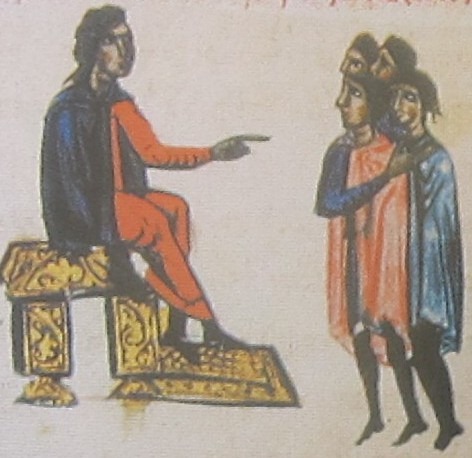
Part of an illustration from the Madrid manuscript of John Skylitzes’ Synopsis of History showing Niketas Oorpyhas casting judgments on Christian apostates.
One rewarding discovery of my research is recognizing that much of what we know about Niketas is legendary. The portage of the Isthmus is entirely a legend, and I do not doubt that the horrific punishments themselves have been invented to make the Emperor Basil appear mightier than he was. I hope to demonstrate this by developing the piece into a little article in the future.
In the meantime, here’s the web version of the BSC paper, stripped of its notes.


 Corinthian Matters
Leave a reply to dpettegrew Cancel reply