We all know that Wikipedia, with its 5 million+ articles, is a first stop for students, the general public, and researchers looking for quick answers to factual questions about the ancient world. In an important article published a decade ago in The Journal of American History, the late Roy Rosenzweig found that this global encyclopedia was less inaccurate than an historian might initially assume for biographies of famous American individuals and in comparison with online encyclopedias such as (then functioning) Encarta and Encyclopedia Britannica. Rosenzweig noted that while Wikipedia was often missing vital scholarly perspectives, interpretation, bibliography, and the full picture, it had all the same become an important source of information and facts for students, teachers, and the broader public. He urged professional historians to enter the game and help make this resource a better one:
Should those who write history for a living join such popular history makers in writing history in Wikipedia? My own tentative answer is yes.63 If Wikipedia is becoming the family encyclopedia for the twenty-first century, historians probably have a professional obligation to make it as good as possible. And if every member of the Organization of American Historians devoted just one day to improving the entries in her or his areas of expertise, it would not only significantly raise the quality of Wikipedia, it would also enhance popular historical literacy. Historians could similarly play a role by participating in the populist peer review process that certifies contributions as featured articles.
Those of us whose research intersects with Corinthian studies have probably seen the problems, holes, and mistakes in many of the articles associated with ancient Corinth and its region. It is a little surprising to me that given the large number of scholars who work on Corinth, the Wikipedia articles on Corinthian studies are in such bad shape. Visit the following articles and tell me that you don’t see room for improvement either in the content, references, or external sites.
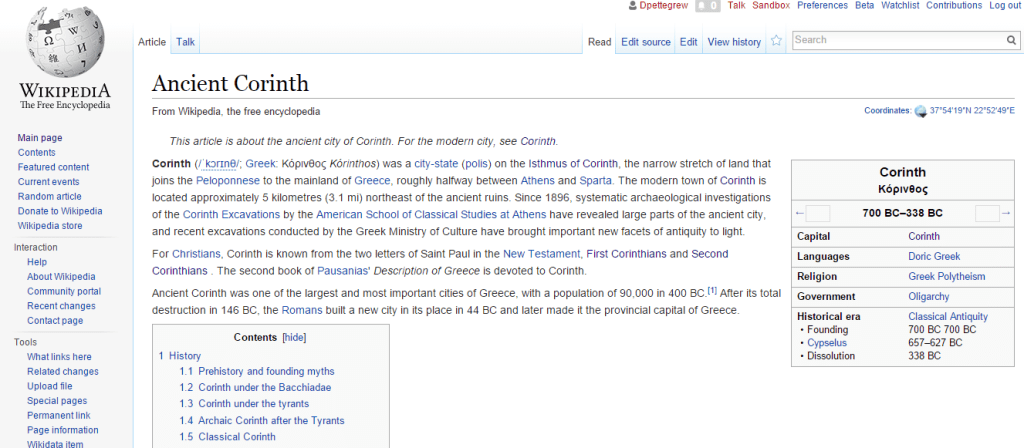
Visit the following articles and tell me that you don’t see room for improvement either in the content, references, or external sites.
But wait, thre’s an opportunity for you to help. I just received an invitation from Phoebe Acheson via the Classics Library Forum listserve to make ancient world Wiki articles better. Acheson writes:
I’m writing to solicit your help by participating in and/or publicizing the Wikipedia Library’s #1Lib1Ref campaign which is scheduled form Jan. 15-23 2016. As described here: https://meta.wikimedia.org/wiki/The_Wikipedia_Library/1Lib1Ref the Wikipedia Library wants to celebrate the 15th anniversary of Wikipedia (!!) and improve the sourcing of articles. They’re asking librarians to help.
I thought this was a great idea (I am not in any way associated with Wikipedia Library) and will be encouraging my blog and twitter followers to participate – even those who are not librarians – by helping to improve the sourcing of articles with classics topics. Will you join me?
You can:
- Make an edit to Wikipedia yourself (it is easy) adding a footnote with reference to a scholarly article, a link to a Worldcat record for a book under the “suggested reading,” or a link to a scholarly web project (i.e. an excavation web site, digital humanities project report, etc.)
- Encourage the classicists you serve to do the same – maybe suggest that teachers pass the idea along to their students, or even devise an assignment or in-class exercise?
- Encourage your librarian colleagues to do the same.
This link (https://meta.wikimedia.org/wiki/The_Wikipedia_Library/1Lib1Ref/Help ) has good and short directions for how to edit Wikipedia for those who have not done so.
At one point, a couple of years ago, the understaffed Wikipedia was unable to accommodate new members and changes (there were delays in signing up). Those glitches seem to be fixed. I just registered and was able to begin editing instantly.
Between January 15 and 23, 2016, join me in updating the references, links, or content to a Corinthian subject that is near and dear to your heart.


 Corinthian Matters
Leave a reply to Katherine Petrole (@kpetrole) Cancel reply