Category: Archaeological Discoveries
-
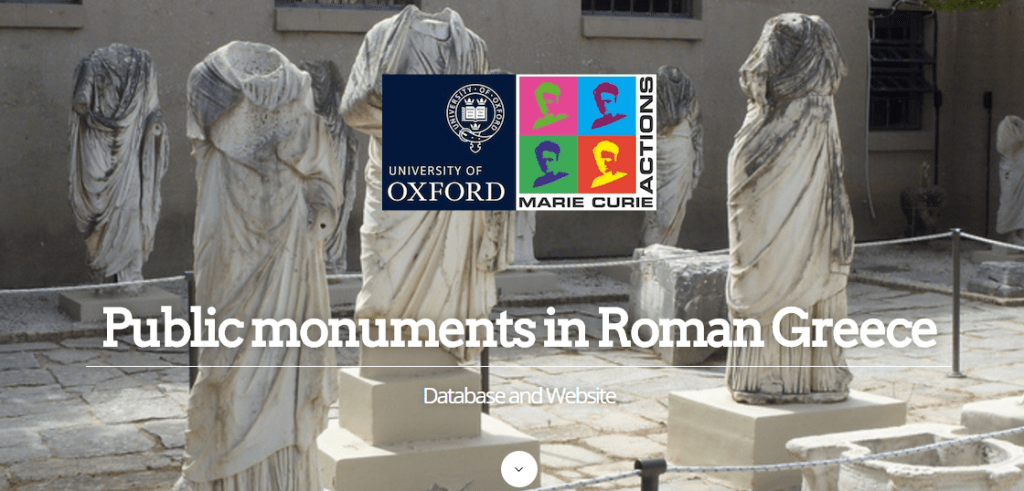
Public Monuments in Roman Greece: A New Database
A colleague sent me this link to Dr. Christopher Dickenson‘s new database and website devoted to the public monuments of Roman Greece. The platform and the content are still under development, but the website already makes available records for a substantial number of monuments known from Pausanias for three cities of Roman Greece. With its aim to presen all monuments known from text and…
-
On the New Investigations at Lechaion
The Lechaion Harbour Project made global news again in late December following the press release of their recent season conducting underwater investigations at Corinth’s northern harbor. We briefly covered the new work of the LHP last year at Corinthian Matters, and now we can happily report on the first fruits of their work there. As the press release from the University…
-
Archaeological Reports (Journal of Hellenic Studies)
The 2014 volume of Archaeological Reports is now out and promises some interesting new studies of the northeast Peloponnese and Greece. If you’re not familiar with Archaeological Reports, the journal is published by the British School at Athens and offers “the only account of recent archaeological work in Greece published in English.” Table of Contents:…
-
Corinthian Scholarship Monthly (December-February). Part 2
Here is the second part to last week’s post about new scholarship in the last three months. You can find the full collection of articles and books related to Corinthian studies at the Corinthian Studies Zotero Page. If you don’t see URLs for articles and books below (they sometimes don’t transfer in the copy), visit…
-
The Corinthia Zotero Library: New Organization
Yesterday I discovered batch tagging in Zotero. Instead of manually changing tags one at a time (an incredibly time-consuming process), one can batch tag by dragging a selection of multiple items onto any tag in the tag selector box in the Standalone version of Zotero. This feature effectively allowed me to tackle the tags in…
-
Corinthian Scholarship Monthly (December-February). Part 1
With the end of last semester, holidays, and deadlines, I fell a bit behind on the Corinthian Scholarship Monthly posts. Yesterday I started to dig out, sift through emails, and find the gems in the bunch. This will be the first of two posts on new scholarship that went live in December to February. I’ll…
-
Excavations at Corinth 2013: Annual Report
The annual report of the American School of Classical Studies at Athens has recently been released. Plenty of Corinthiaka inside, including a report on the 2013 field season at Corinth, and wider work in the region. Here is a snippet: “Excavations at Corinth during 2012–13 continued under the direction of Guy D.R. Sanders, with Ioulia…
-
The Corinthia and the Northeast Peloponnese
Thanks to Jeremy Ott in notifying the Corinthian Studies FB group that the long-awaited publication of the Loutraki 2007 conference is now available in print: W.-D. Niemeier and N Kissas, eds., The Corinthia and the Northeast Peloponnese: Topography and history from prehistoric times until the end of antiquity. 2013: Hirmer Verlag GmbH. I’m guessing these…
 Corinthian Matters